
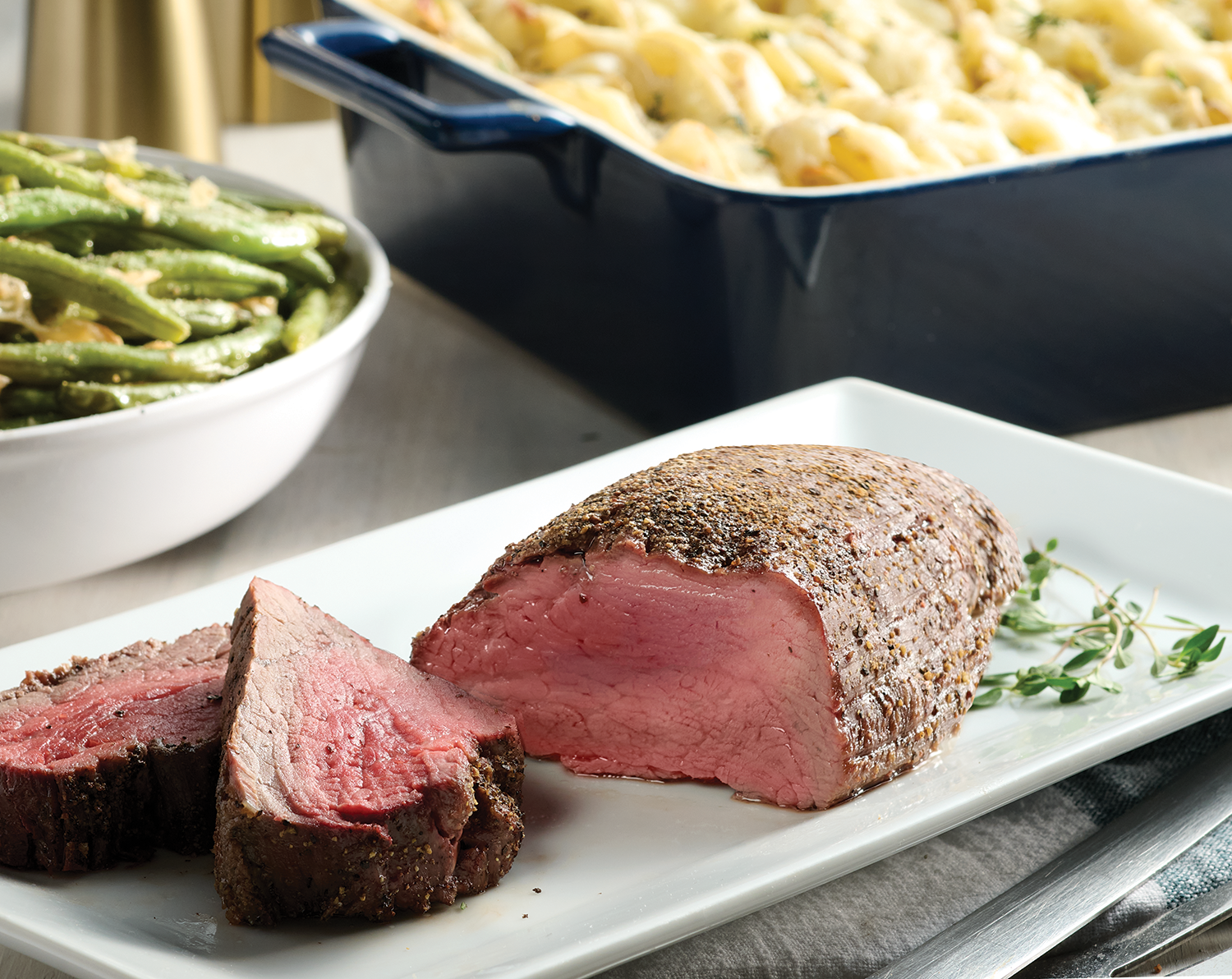
Classic Prime Rib Roast
During the holiday season (or any season, for that matter), you can’t go wrong with this Classic Prime Rib Roast recipe! We are keeping it simple with Member’s Mark™ Black Peppercorn and Pink Himalayan Salt Grinders – which only enhance the flavor of the prime rib, rather than covering it up!
Prime Rib Doneness Chart
For that perfect pink center, here’s what to aim for when using a meat thermometer. In this recipe, we are aiming for 130°F, but the choice is yours!
Remember: The internal temperature will continue to rise slightly even after removing the roast from the oven due to carryover heat.
| Doneness | Internal Temp to Remove from Oven | Final Temp After Resting (10–20 min) | Color & Texture |
|---|---|---|---|
| Rare | 115–120°F | 120–125°F | Deep red center, very juicy, soft |
| Medium-Rare (ideal) | 125–130°F | 130–135°F | Warm red center, juicy, tender |
| Medium | 135–140°F | 140–145°F | Warm pink center, slightly firmer |
| Medium-Well | 145–150°F | 150–155°F | Mostly brown with slight pink, firmer |
| Well Done | 155–160°F+ | 160–165°F+ | Fully brown, firm, least juicy |
How to Tie Prime Rib Roast into a Uniform Shape
Method 1 — The Classic Butcher’s Loop (Quick & Easy)
1. Position the Roast
Place the roast fat-side up on a cutting board. Slide it so the narrow ends face left and right.
2. Cut Several Pieces of Twine
Cut 5–6 pieces, each about 2–3 feet long depending on the roast’s width.
(1 tie every 1.5–2 inches)
3. Create the First Loop
-
Slide a piece of twine under the roast.
-
Bring both ends up and make a standard overhand knot, but don’t tighten fully yet.
-
Adjust the loop so it sits where the roast is the most uneven or loose.
4. Tighten Firmly
Pull both ends so the roast gently compresses into a uniform cylinder—snug but not squeezing out juices.
5. Double Knot
Add a second knot so it won’t slip.
6. Continue Down the Roast
Repeat steps with the remaining pieces, spacing ties about every 1.5–2 inches.
Make sure they’re all equally tight so the roast cooks evenly.
Method 2 — Continuous “Butcher’s Spool Tie” (Professional Look)
This creates a neat, evenly spaced spiral and avoids cutting multiple pieces.
1. Anchor the Twine
-
Cut a long piece of twine (6–7 ft for a typical 3–4 rib roast).
-
Slide under the roast near one end.
-
Tie a tight double knot.
2. Create Loops Without Cutting
-
Hold the long working end of twine.
-
Loop it forward over the roast, then slide your hand under to bring the twine back toward you, forming a large loop.
-
Tighten it around the roast about 1.5 inches forward from the last one.
3. Repeat
Continue looping → tightening → sliding forward until you reach the opposite end of the roast.
4. Finish
Flip the roast over and run the twine straight back along the bottom, weaving it under the loops for stability.
Tie off at the starting knot.
Extra Tips for Perfect Tying
-
Tie before seasoning if you want super neat lines.
-
Tie after seasoning if you prefer rub inside the creases.
-
If the rib bones were cut off (a “detached roast”), tie the meat back onto the bones with 2–3 firm loops to act as a natural roasting rack.
-
Tighten gradually — overtightening can distort the roast or cause uneven cooking.

Classic Prime Rib Roast
Ingredients
- 4 lb Boneless rib roast
- 2 tbsp Member's Mark™ Himalayan Pink Salt Grinder
- 1 tbsp Member's Mark™ Black Peppercorn Grinder
- Kitchen twine

Instructions
- Remove prime rib from the refrigerator and let sit at room temperature for 3 hours.
- Thirty minutes before cooking, preheat the oven to 500℉.
- Generously season the roast on all sides with Member's Mark™ Himalayan Pink Salt Grinder and Member's Mark™ Black Peppercorn Grinder.
- Use kitchen twine to tie the roast into a uniform shape. (See notes above.)
- Place the roast fat-side up on a roasting rack set inside a pan.
- Place the roast in the oven and roast for 20 minutes. Depending on the size of your prime rib, you can calculate the roasting time by multiplying the weight (in pounds) by 5.
- After the roasting time, turn off the oven and do not open the door. Let the roast rest inside for 2 hours.
- Use an instant-read thermometer to check doneness if unsure — aim for 130°F for medium-rare.
- After 2 hours, remove from the oven, slice, and serve immediately.